
Bat Removal Payson, UT
Payson was settled on Peteetneet Creek in 1850, and almost one in ten of its homes still dates from before 1940. Those older brick houses sit beside 2000s and 2010s subdivisions on the city's edges. Here is who handles a bat in Payson, what recent rabies testing in Utah County and the counties to the south shows, and when a colony can legally be sealed out.
Who to call in Payson
- Animal control: Payson runs its own animal control department, budgeted at $260,090 for fiscal 2027 in the city's approved budget, rather than relying on the county. Call the Payson Police Department at 801-465-5240 (405 W Utah Ave) or the 24-hour non-emergency line, 801-798-5600, and ask for animal control. Use 911 for an emergency.
- Shelter: animals picked up in Payson go to the South Utah Valley Animal Shelter (SUVAS) in Spanish Fork, 801-851-4080, which serves Payson along with Elk Ridge, Mapleton, Provo, Salem, Santaquin, Spanish Fork, Springville and Woodland Hills.
- Possible exposure: Utah County Health Department, 801-851-3000 (main office in Provo). The department also has a Payson office for clinic and vital-records services. Call if anyone was bitten or scratched, touched the bat, or woke up with it in the room.
- State wildlife office: Utah DWR's Central Region, 1115 N Main St, Springville, 801-491-5678.
A bat colony living in an attic or wall isn't an animal control job. Bats are protected in Utah, and Utah DWR says a homeowner with a colony should call a local, permitted wildlife nuisance control company, which coordinates the removal with DWR at a time of year that won't harm the pups.
A bat in the house: keep it if there's any chance of contact
If nobody touched the bat and it wasn't in a room with someone asleep, a young child or a pet, close the interior doors, open a window or outside door and let it leave. If there was any chance of contact, don't let it go. Utah DHHS says not to touch, hit or destroy the bat, because the lab needs it intact; its capture sheet says to wait for the bat to land, put on heavy leather gloves, cover it with a container, slide cardboard underneath and tape it shut. The rabies FAQ adds that bat bites can be small enough to go unnoticed.
Rabies in Utah County and to the south
Utah County hasn't had a rabid animal in the last two state reports. In 2025 the Utah County Health Department sent 55 animals to the state lab: 50 were negative and 5 couldn't be tested, usually because the specimen was too damaged. The 2024 report also listed no rabid animals from Utah County. That doesn't mean Payson's bats are rabies-free. Payson sits at the south end of the county, and Juab County, just south of Santaquin, had a rabid bat in 2025. Sanpete County had two in each of 2024 and 2025. Statewide in 2025, all 24 rabid animals were bats, out of 240 bats tested (10.0%), and they exposed at least 19 people and 26 pets. The state reports don't break the numbers down by city.
Five unusable specimens out of 55 is the practical lesson. A bat that has been swatted, crushed or left in the sun for days may not be testable, and then the health department has to decide on treatment without an answer.
Bats around Payson
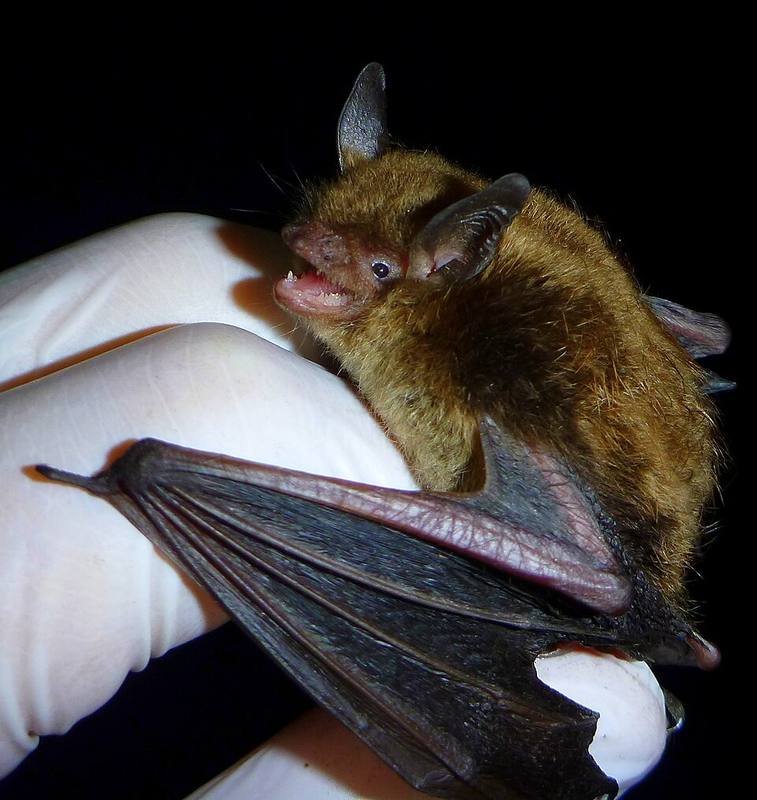
Utah DWR says Utah has 18 confirmed bat species and that groups of bats found in buildings are often maternity colonies, with females moving in around May or June to give birth. USU Extension calls the big brown bat the most common bat in Utah and says about half of Utah's species will use human dwellings. Statewide in 2025, Mexican free-tailed bats were the largest share of rabid bats (8 of 24), followed by silver-haired bats (5) and big brown bats (4). DWR notes that five Utah species migrate, leaving from late August through October, which is why bat calls tend to jump in September. Payson's creek bottoms and farm fields at the foot of the mountains gives bats plenty of insects to feed on close to town.
Payson homes: an 1850 fort town with an old core
The Payson Historical Society's walking tour says three wagons, led by James Pace with the Stewart and Searle families, reached the site on October 20, 1850. The settlement was called Peteetneet, after a Ute leader who lived in the area, and the first fort was built of logs from the creek banks. A larger fort with an eight-foot adobe wall, about four city blocks square, followed in 1853, and the territorial legislature incorporated Payson City on January 21, 1853.
That age shows in the housing. Payson has 7,146 housing units with a median build year of 1997 (ACS 2024 5-year). About 10% were built before 1940 and another 9% in the 1940s through 1960s; 15% came in the 1970s, 25% in the 2000s and 21% since 2010. Single-family detached houses are 78% of units, and 18% of occupied homes are rented. Households average 3.35 people, against 2.97 statewide.
USU Extension says bats don't chew their own holes. They use existing gaps of about ¼ inch or more and prefer entries 12 feet or higher. On Payson's pre-1940 brick homes, look at gaps where the brick meets the soffit and fascia, at old chimneys and around gable louvers. On the 1970s ramblers, check the roof-to-wall joints and attic vents. On newer two-story homes, the usual spots are gable vents, the ends of ridge vents and gaps where trim was cut short. Utah DHHS's bat-proofing sheet adds soffit and ridgeline vents, plumbing vents through the roof, electrical conduit entries, crawl space vents and chimneys, and notes that a bat can fit through an opening as small as 3/8 inch. Our Utah bat-proofing checklist covers each one.
When bats can be excluded in Payson
The Utah Division of Wildlife Resources (DWR) says female bats usually move into buildings in May or June to give birth, and that June through August is the hardest time to deal with a colony. Blocking the mothers then kills the flightless pups, and bats are protected wildlife in Utah. Unless bats are coming into close contact with people, DWR does not permit colony removal during that period. DWR advises against sealing openings from May through August and names fall as the best time.
For an attic colony, DWR says to contact a local, permitted wildlife nuisance control company, which coordinates the removal with DWR for a time of year that won't harm the pups. After August, DWR describes hanging bird netting over an exterior opening (stapled at the top and sides, open at the bottom) for four to five days, until the bats have left, and then sealing the holes. In Payson, NOAA normals for the Santaquin Chlorinator station put the average low at 50°F or warmer in Jun–Sep, the months when bats are most active here.
The Santaquin NOAA station, about 5.8 miles from central Payson, averages lows of 51°F in September and 38°F in October, with a January low of 20°F and a July high of 90°F. In practice, Payson's exclusion window runs from September, once the pups are flying, into early October, before the nights get cold enough that bats stop leaving the roost every evening. A colony found in June or July can be inspected and mapped now so the work is ready for that window.
Payson at a glance
- Housing units: 7,146 (median year built 1997)
- Built before 1980: 33%; built 2010 or later: 21%
- Single-family detached: 78%; buildings with 10+ units: 8%
- Renter-occupied homes: 18%
- Average January low: 20°F; average July high: 90°F
- Months with an average low of 50°F or warmer: Jun–Sep
Housing figures: U.S. Census Bureau, ACS 2024 5-year estimates (tables B25024, B25034, B25035, B25003) via Census Reporter. Climate: NOAA 1991–2020 normals, Santaquin Chlorinator station.
Common questions
Who do I call about a bat in my Payson home?
Call the Payson Police Department at 801-465-5240, or the 24-hour non-emergency line at 801-798-5600, and ask for animal control; Payson runs its own animal control department. If anyone may have touched the bat, or it was in a room where someone was sleeping, also call the Utah County Health Department at 801-851-3000 and keep the bat for testing.
Have rabid bats been found near Payson?
Not in Utah County in the last two state reports. The Utah County Health Department sent 55 animals for testing in 2025 and none were positive, and the 2024 report also listed none from the county. But Juab County, just to the south, had a rabid bat in 2025, and Sanpete County had two in each year, so any bat that may have touched someone should be tested.
Will Payson animal control remove bats from my attic?
No. A bat colony in a house is not an animal control job. Bats are protected in Utah, and Utah DWR says homeowners with a colony should hire a permitted wildlife nuisance control company, which times the removal with DWR. Animal control and the health department deal with single bats that may have exposed a person or pet.
How do bats get into older Payson homes?
Through existing gaps. USU Extension says bats don't chew holes but will use any opening of about a quarter inch or more, usually 12 feet or higher. On Payson's older brick homes that often means gaps where the brick meets the soffit or fascia, loose gable louvers and old chimneys. About 10% of Payson's housing was built before 1940.
When can bats be sealed out of a Payson house?
After the pups can fly. Utah DWR advises against sealing openings from May through August and names fall as the best time. Payson's nearest NOAA station averages a September low near 51°F and an October low near 38°F, so the usual window is September into early October.
Nearby city guides
Sources
- Payson City: Payson Police (405 W Utah Ave; 801-465-5240; 24-hour non-emergency 801-798-5600)
- Payson City: Approved budget for the period ending June 30, 2027 (Animal Control, Dept 4222, PDF)
- South Utah Valley Animal Shelter: About (cities served, including Payson)
- Utah County Health Department: Contact us (main line and Payson office numbers)
- Utah DHHS: Rabies Annual Report 2025 (results by local health jurisdiction)
- Utah DHHS: Rabies Annual Report 2024
- Utah DHHS: How to safely catch a bat (PDF)
- Utah DHHS: Frequently asked questions about rabies (PDF)
- Utah DHHS: Stay away from bats (inspecting and bat-proofing buildings, PDF)
- Utah DWR: Contact us (Central Region office, Springville)
- Utah DWR: What to know about bats in Utah (July 14, 2026)
- Utah State University Extension: Bats (Wildlife Damage Management Series, PDF)
- Payson City: Historical Walking Tour (Payson Historical Society; 1850 settlement and the 1853 fort)
- Payson City: The Payson Story, centennial history 1850-1950 (PDF)
- Census Reporter: Payson and Utah average household size (ACS 2024 5-year, table B25010)
- Census Reporter: Payson year structure built (ACS 2024 5-year, table B25034)
- Census Reporter: Payson profile (ACS 2024 5-year)
- NOAA NCEI 1991–2020 monthly normals (Santaquin Chlorinator)
Other Utah cities we serve
We serve all of Utah. Here are nearby service areas.
Other wildlife removal services we offer here
Payson bat removal, done right.
Call for a phone consultation. Written warranty. UDWR licensed. Same-day available. Call to schedule an inspection.