Bat Removal Springville, UT
Springville handles animal calls through its police department, sends strays to the South Utah Valley Animal Shelter in Spanish Fork, and relies on the Utah County Health Department to decide whether a bat needs a rabies test. Springville is also home to Utah DWR's Central Region office. Here is who to call, what Springville's own code says about bites, and how the city's older homes near Main Street and its newer subdivisions let bats in.
Who to call in Springville
- Animal control: Springville's animal control officer works for the Springville Police Department and, according to the city, handles nearly 2,000 cases a year, from strays to sick and injured animals. Call the police non-emergency line at 801-489-9421, or 911 in an emergency.
- Shelter: Springville doesn't keep animals in a city shelter. Animals picked up in Springville go to the South Utah Valley Animal Shelter (SUVAS), 582 W 3000 N in Spanish Fork, 801-851-4080, which also serves Provo, Mapleton, Spanish Fork, Payson, Salem, Santaquin, Elk Ridge and Woodland Hills.
- Possible exposure: Utah County Health Department, 151 S University Ave, Provo, 801-851-3000. Utah DHHS epidemiologists also take calls at 1-888-EPI-UTAH.
- State wildlife office: Utah DWR's Central Region office is in Springville at 1115 N Main St, 801-491-5678.
Springville's 24-hour bite rule
Springville's city code has its own rabies article. Section 3-7-401 says anyone bitten by an animal must report the bite to an animal control officer or the health department within 24 hours, whatever the species. Anyone who knows that a person or animal was bitten by a species that can carry rabies must report it immediately. Doctors who treat a bite must report it too. Bats are the species that matter most here: Utah DHHS says the bat variant is the only rabies variant known to be in Utah.
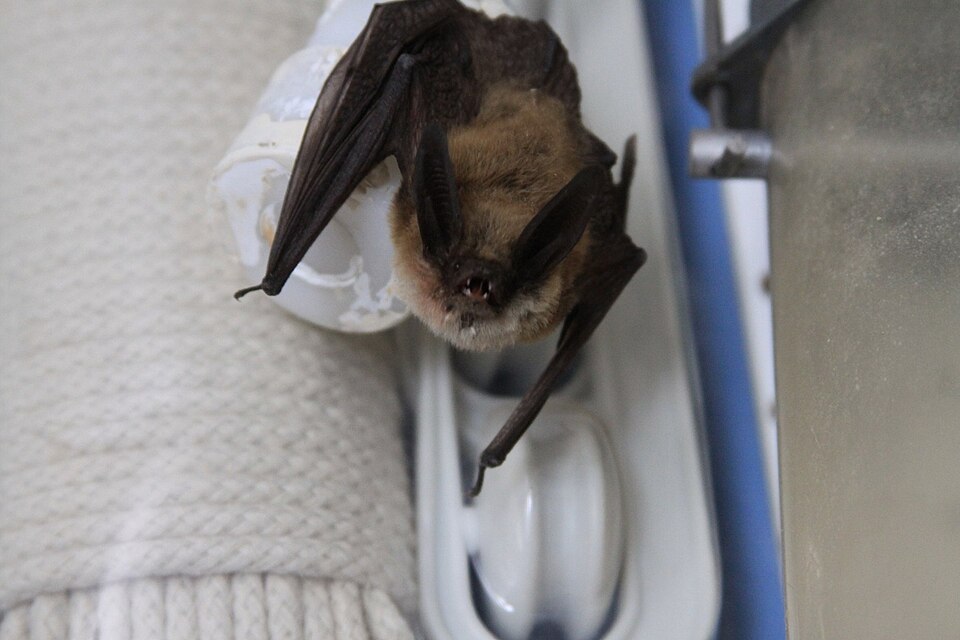
A bat bite is easy to miss. DHHS says a bite or scratch from a bat may not always be visible, and someone who sleeps in the same room as a bat could be bitten or scratched and not know it. That is why DHHS treats a bat found in a room with a sleeping person or an unattended child, or one that touched a person or pet, as a bat that should be tested. In Springville, call the police non-emergency line so an officer can collect it, and the Utah County Health Department to assess the exposure. If no one can come, the DHHS capture sheet says to wear heavy gloves, wait for the bat to land, cover it with a container, slide cardboard underneath, tape it shut, label it "LIVE BAT" and call the health department.
The same code requires Springville owners to vaccinate dogs and cats against rabies at three months and to keep them current. That matters because pets find bats too: statewide, the 24 rabid bats found in 2025 exposed at least 26 pets.
Rabies in Utah County
The Utah County Health Department sent 55 specimens to the state lab in 2025: none were positive, 50 were negative and 5 couldn't be tested. The county also had no positives among 65 specimens in 2024. Counties to the north did: Salt Lake County had 8 rabid bats in 2025 and Davis County 4. All 24 rabid animals Utah found in 2025 were bats, out of 240 bats tested (10.0%), and most positives turn up between June and October. Bats fly and migrate, so a clean county record doesn't make it safe to handle one in Springville.
Springville homes: where bats get in
Springville has 11,320 housing units with a median build year of 1996 (ACS 2024 5-year). It has more old housing than most Utah County suburbs: about 11% of homes were built before 1950 (7% before 1940), and another 13% in the 1970s. The newer side of town is large too: about 16% of homes date from the 1990s, 24% from the 2000s and 20% from 2010 on. Single-family detached houses are 65% of units, townhomes and other attached houses about 11%, duplexes and three- or four-unit buildings about 11%, and mobile homes about 3%. 28% of occupied homes are rented.
USU Extension says bats don't chew new holes; they use existing gaps of about ¼ inch or more, usually high on a building. DHHS's guidance for bat-proofing buildings puts the minimum at 3/8 inch and lists soffit and ridge vents, plumbing vents through the roof, electrical conduit entries, crawl space vents, loose door and window frames, and chimneys. On Springville's pre-1950 homes near downtown, that means brick chimneys, gable vents, and fascia and trim boards that have pulled away over the decades. On older homes converted to duplexes or with additions, check where the addition's roof meets the original wall. On 1990s to 2010s two-story homes, look at soffit returns, the ends of ridge vents and the seam where a garage roof meets the upper wall. On townhome rows, one gap in a shared roofline can let bats into several units.
Bats along Hobble Creek
Springville sits at the mouth of Hobble Creek Canyon, and Hobble Creek runs through town toward Utah Lake. Utah DWR says bats rely on standing water for drinking and as a source of insects, and that females need more water while they nurse. Bats feeding at dusk over the creek, parks and ponds are normal and not a problem on their own; the concern is a bat inside, on the ground or roosting in a building. USU Extension calls the big brown bat the most common bat in Utah; it was one of the species found rabid in Utah in 2025 (4 of 46 tested), along with Mexican free-tailed bats (8 of 63) and silver-haired bats (5 of 29). DWR says five Utah species migrate, leaving from late August through October and returning in April and May, and that encounters often spike in September.
When bats can be excluded in Springville
The Utah Division of Wildlife Resources (DWR) says female bats usually move into buildings in May or June to give birth, and that June through August is the hardest time to deal with a colony. Blocking the mothers then kills the flightless pups, and bats are protected wildlife in Utah. Unless bats are coming into close contact with people, DWR does not permit colony removal during that period. DWR advises against sealing openings from May through August and names fall as the best time.
For an attic colony, DWR says to contact a local, permitted wildlife nuisance control company, which coordinates the removal with DWR for a time of year that won't harm the pups. After August, DWR describes hanging bird netting over an exterior opening (stapled at the top and sides, open at the bottom) for four to five days, until the bats have left, and then sealing the holes. In Springville, NOAA normals for the Provo Byu station put the average low at 50°F or warmer in Jun–Sep, the months when bats are most active here.
Springville doesn't have a NOAA station with full normals, so these figures come from Provo BYU, about 6 miles northwest and at a similar elevation. It averages lows of 52°F in September, 41°F in October and 32°F in November, with a January low of 24°F. In practice, September through mid-October is the window for one-way exclusion in Springville: pups are flying and nights are still mild enough for bats to find another roost. A winter inspection can map every opening so it is ready to seal at the next safe window.
Springville at a glance
- Housing units: 11,320 (median year built 1996)
- Built before 1980: 33%; built 2010 or later: 20%
- Single-family detached: 65%; buildings with 10+ units: 8%
- Renter-occupied homes: 28%
- Average January low: 24°F; average July high: 95°F
- Months with an average low of 50°F or warmer: Jun–Sep
Housing figures: U.S. Census Bureau, ACS 2024 5-year estimates (tables B25024, B25034, B25035, B25003) via Census Reporter. Climate: NOAA 1991–2020 normals, Provo Byu station.
Common questions
Who picks up a bat in a Springville house?
Springville Police Department animal control. Call the police non-emergency line at 801-489-9421, or 911 in an emergency. If anyone may have touched the bat, or it was in a room where someone was sleeping, also call the Utah County Health Department at 801-851-3000.
Do I have to report a bat bite in Springville?
Yes. Springville City Code § 3-7-401 says a person bitten by an animal must report it to an animal control officer or the health department within 24 hours, and anyone who knows of a bite from a species that can carry rabies must report it immediately. For a bat, call the Utah County Health Department right away and see a doctor.
Will the DWR office in Springville remove bats from my house?
Utah DWR's Central Region office is in Springville (1115 N Main St, 801-491-5678), but DWR says homeowners with bats in an attic should contact a local, permitted wildlife nuisance control company, which coordinates the removal with DWR at a time of year that won't harm the pups.
Has Utah County had rabid bats recently?
Not in the last two DHHS reports. Utah County had no positives among 55 specimens in 2025 or 65 in 2024. But all 24 rabid animals found in Utah in 2025 were bats, including 8 in Salt Lake County and 4 in Davis County, so any bat contact in Springville should be reported.
When can bats be sealed out of a Springville home?
Utah DWR advises against sealing openings from May through August while pups can't fly, and doesn't permit colony removal from June through August unless bats are in close contact with people. With average September lows near 52°F and October lows near 41°F at the nearby Provo BYU station, September to mid-October is the best window.
Nearby city guides
Sources
- Springville City Police: Animal Control
- Springville City: Phone directory (police non-emergency)
- Springville City Code, Title 3 Ch. 7 Art. 4: Rabies Control (§ 3-7-401 to 3-7-403)
- South Utah Valley Animal Shelter: About (cities served)
- Utah County Health Department: Contact us
- Utah DHHS: How to safely catch a bat (PDF)
- Utah DHHS: Frequently asked questions about rabies (PDF)
- Utah DHHS: Stay away from bats (bat-proofing camp buildings, PDF)
- Utah DHHS: Rabies Annual Report 2025
- Utah DHHS: Rabies Annual Report 2024
- Utah DWR: Contact us (regional offices; Central Region office in Springville)
- Utah DWR: What to know about bats in Utah (July 14, 2026)
- Utah State University Extension: Bats (Wildlife Damage Management Series, PDF)
- Census Reporter: Springville profile (ACS 2024 5-year)
- NOAA NCEI 1991–2020 monthly normals (Provo Byu)
Other Utah cities we serve
We serve all of Utah. Here are nearby service areas.
Other wildlife removal services we offer here
Springville bat removal, done right.
Call for a phone consultation. Written warranty. UDWR licensed. Same-day available. Call to schedule an inspection.